
Fair Play for Events, Programs, and DUPR Sessions
Fair Play means every participant has an equal opportunity to participate and compete.
MyCommunityLives (MCTL) supports Fair Play for programs, leagues, clinics, round robins, lessons, social events, DUPR sessions, and shared participation opportunities.
The same fairness challenge that exists for court reservations also exists for organized events.
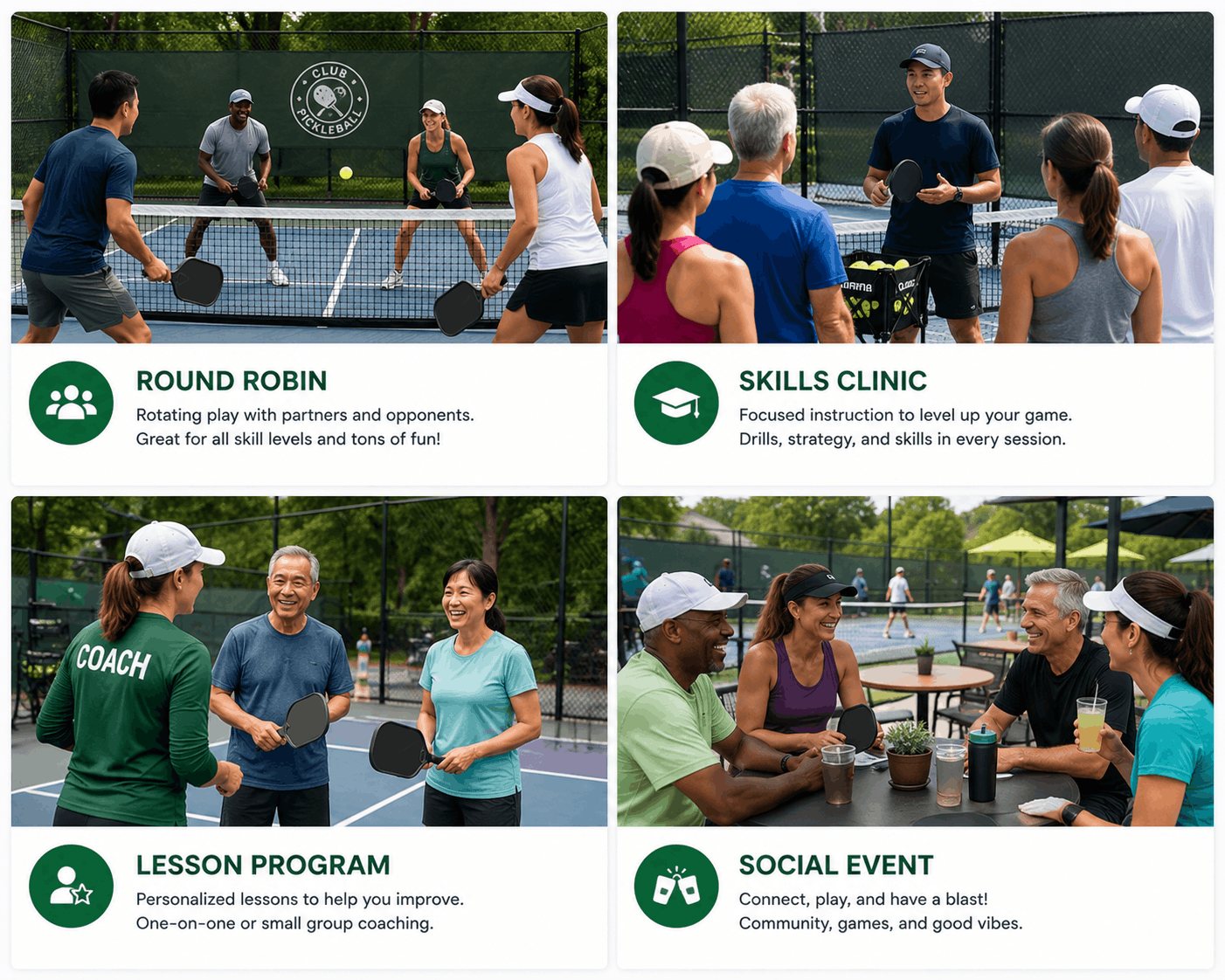
Lessons. Round robins. Leagues. Social events. Skills clinics.
Many events fill immediately. The fastest registrants get in. Everyone else is waitlisted.
Events may operate using traditional first-come, first-served registration. Or organizers may choose a fairness-based lottery model when demand exceeds available capacity.
Unlike basic event registration tools, the Fair Play approach helps organizers understand demand before they decide how to respond.
Measure Demand Before Choosing Capacity
Instead of guessing demand, organizers can measure it.
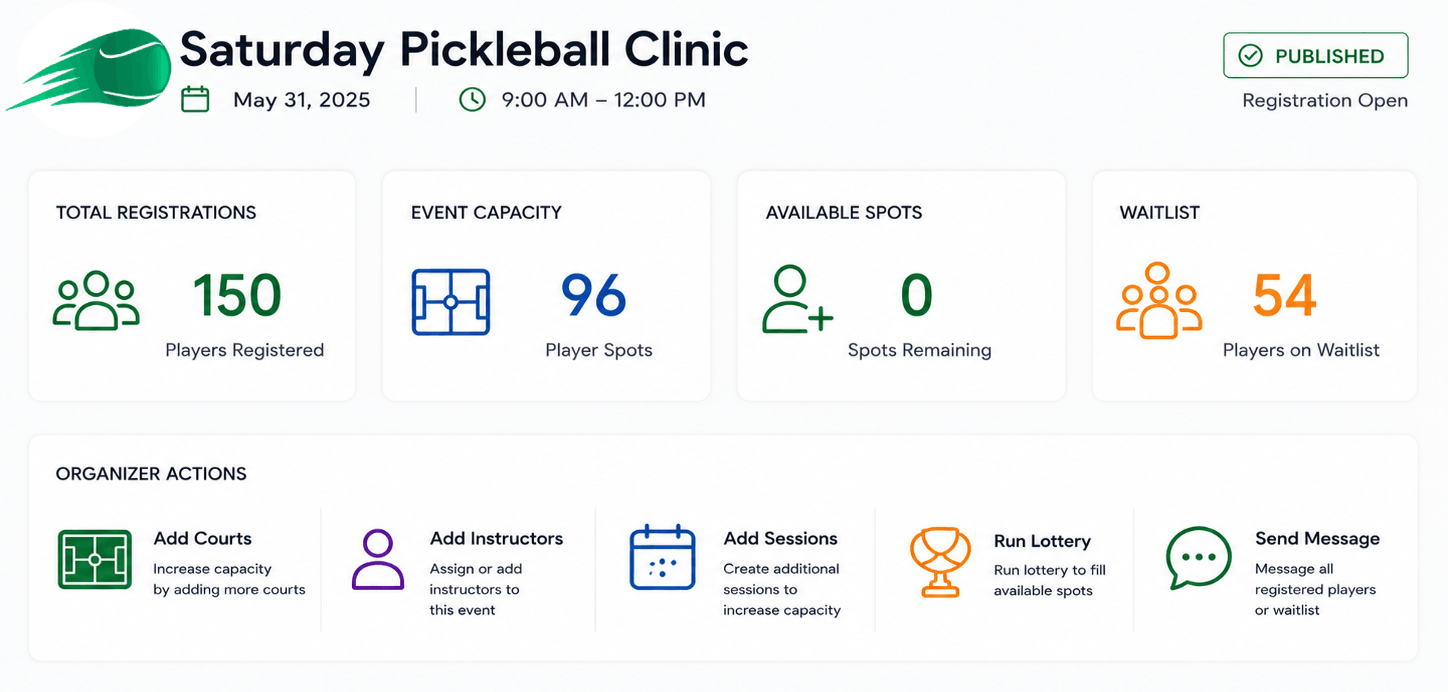
For example, 150 players may register for an event with capacity for 96 players. With visible demand, the organizer can make a better decision:
- Add courts.
- Add instructors.
- Create additional sessions.
- Run a lottery.
This creates better planning, better participation, and a stronger perception of fairness throughout the membership.
Programs Need Fair Access Too
Court sports organizations do more than rent court time.
They create clinics, round robins, lesson programs, league schedules, skills sessions, and social events. These experiences help members improve, compete, and connect with others.
When the same members repeatedly get into the most desirable programs, other members can feel excluded. That weakens participation and can reduce the perceived value of membership.
Fair Play gives organizers a way to support demand without turning every popular program into a speed contest.
Fair Play for DUPR Sessions
Fair Play begins before the first point is played. When demand exceeds available courts, participants can be selected through a fair lottery so every player has an equal opportunity to participate.
For DUPR sessions, competitive play should focus on the opportunity to perform, not speed of registration or familiarity with the organizer. Players can be grouped within appropriate skill ranges and, when useful, age ranges. Within those groups, partners and opponents can be randomized across rounds.
This creates a more diverse mix of matchups among comparably skilled players. It can reduce selection bias, improve the competitive experience, and support more representative results for DUPR ratings.
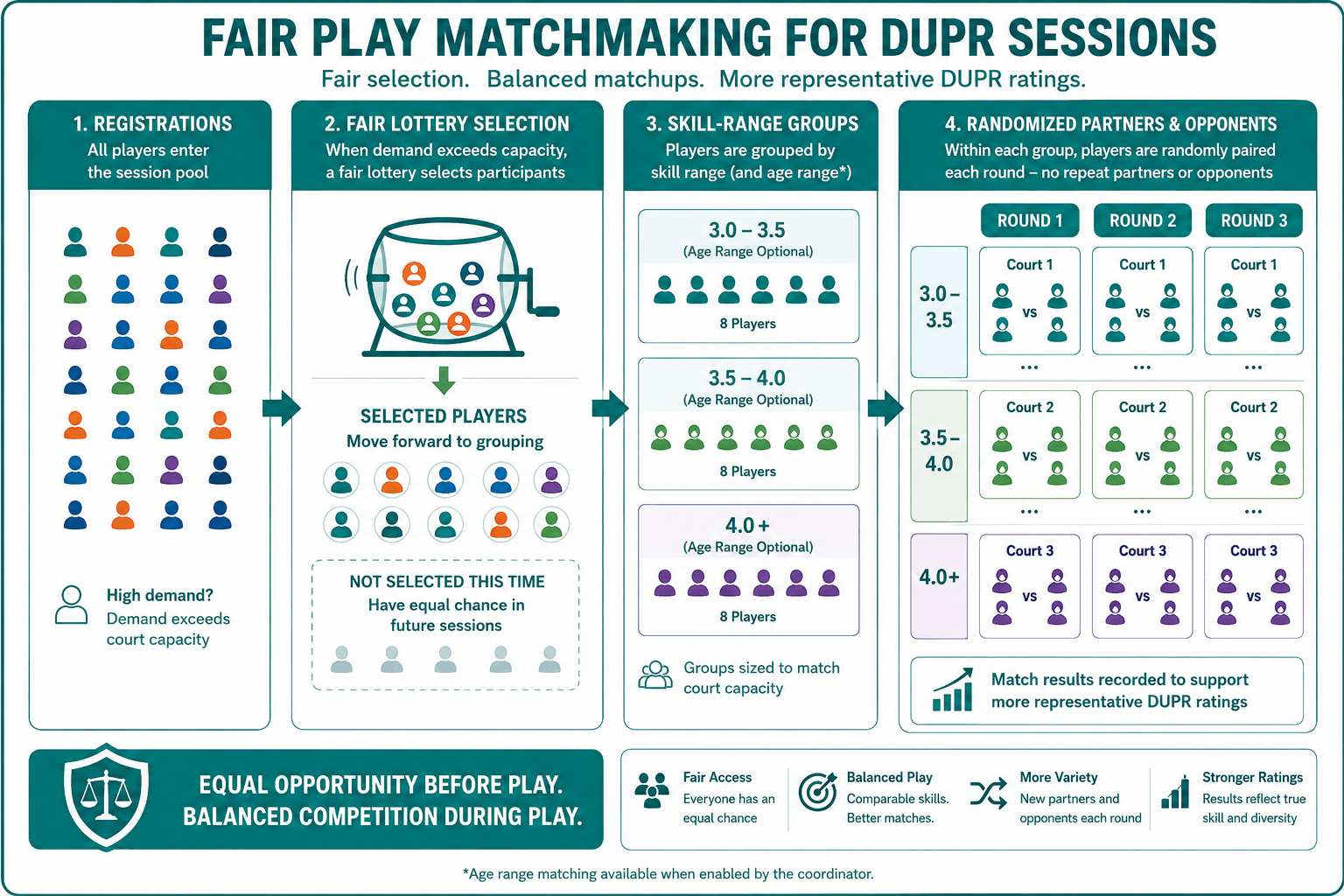
Fair Play supports DUPR sessions through:
- Fair lottery selection when registrations exceed capacity.
- Skill-range grouping for balanced competition.
- Randomized partners and opponents across every round.
- Diverse matchups that reduce bias.
- Better competitive experiences and more representative results.
Instead of rewarding whoever registers first, Fair Play creates equal opportunity before competition begins and balanced competition once play starts.
Better Planning for Clubs, Parks, and Community Sports
Demand data helps organizations see what members actually want.
If a clinic fills immediately, the question is not only who got in. The better question is how much demand existed, when it existed, and what the organization can do next.
With better demand visibility, organizations can decide whether to expand capacity, create a second session, adjust staffing, or use fair allocation when capacity cannot be expanded.
FAQ
What is Fair Play?+-
Fair Play is a philosophy and the foundation of a club culture.
Every club eventually reaches the same challenge. Demand exceeds supply.
There are only so many courts. Only so many swim lanes. Only so many instructors. Only so many prime-time hours.
Members understand scarcity. What they struggle with is inconsistency.
When opportunities appear to favor the fastest click, the earliest arrival, or the same familiar faces, confidence begins to erode.
Fair Play replaces uncertainty with confidence and trust.
Every member knows and can participate in the process. Every member has a fair opportunity.
Members are remarkably accepting of limited availability when they believe everyone has a fair chance.
Fairness transforms competition against other members for time slots into confidence that I get my share.
The result isn't simply better scheduling. It's a stronger club culture.
It is a valued and loyal member. Retention is retained.
Why Club Culture Matters+-
This is where your identity becomes different.
Most club technology manages operations.
Opark strengthens relationships.
Members stay where they feel valued.
Transparency creates trust.
Trust creates community.
Community creates retention.
OparkInc products
Contact / Demo
Create More Fair Playing Opportunities
Talk with OparkInc about MyClubLives reservation software, MyCommunityLives community events software, demand visibility, and networked access for clubs, parks, tennis centers, and community sports organizations.
Request a Demo